From the observatory to the boardroom - Part 1

I built a production-ready mobile web app in 7 days. Alone.
Not a prototype. Not a proof of concept. A fully architected app with authentication, a cloud database, third party API integrations, and a subscription paywall.
This three part series will cover the process I used to build the app, the risks and learnings, and how senior leaders can apply this in their AI adoption journey.
But before I get to the how, let me tell you why.
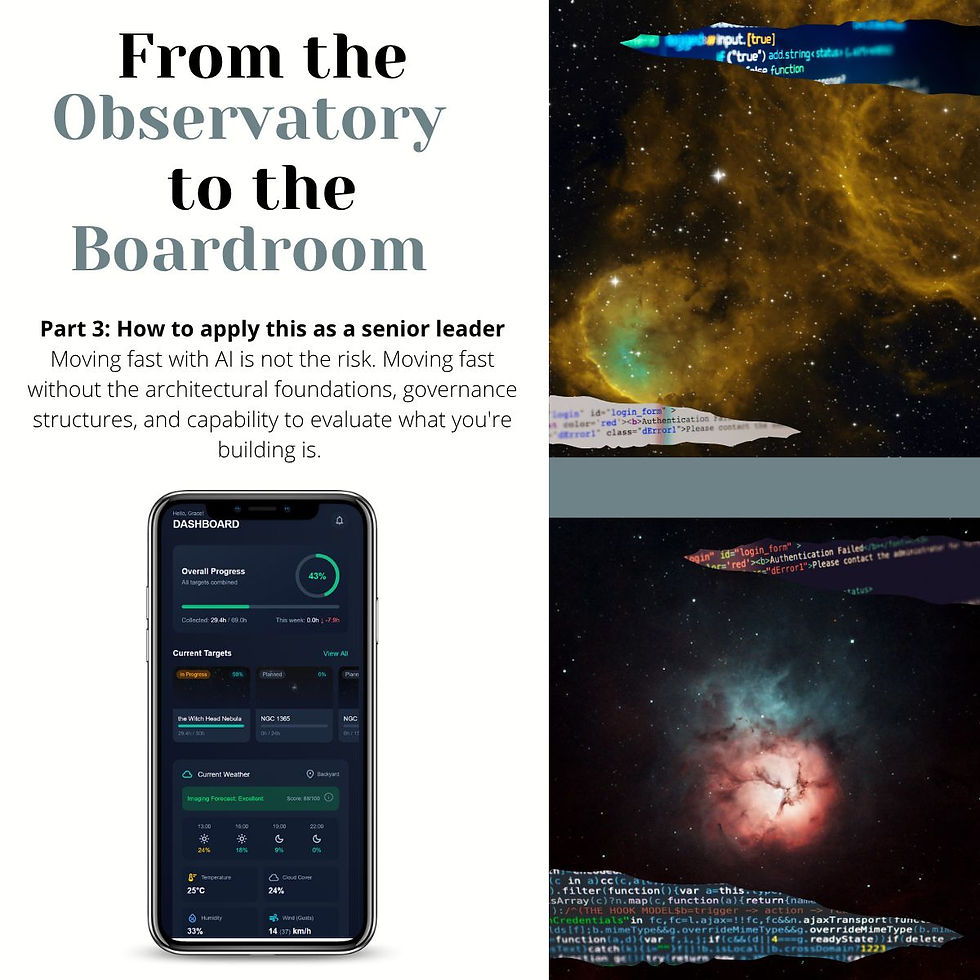
If you’ve worked with me then you’ll know one of my passions is space, and specifically astrophotography. Capturing deep sky objects through a telescope in the dark hours of the morning is the perfect place to be. I ran into a challenge late last year with the organisation of my data - targets are usually photographed over multiple nights to ensure you get enough exposure through each kind of filter (a longer post for another platform and another day). I was using Excel to organise the details about my data after each night of imaging but I felt that the process could be improved and after chatting to a colleague about AI-supported development StellarLog was born.
I spend a lot of time advising senior leaders and executives on AI and data readiness. I talk about the turbulence of adoption, the gap between what management thinks their organisation has and what actually exists, and the courage it takes to move forward without the perfect conditions. I’ve seen the hesitation, the governance gaps, and the missed opportunities. This gave me the opportunity to test the same challenges I see executives wrestling with everyday.
My background is in software development, but I’ve spent the last 7 years in management and strategy. I still understand how to architect systems, but I’m not writing production code day-to-day. So I approached this in the same way I approach any transformation project: with a clear brief, a structured plan, and a willingness to iterate.
I used Claude (Anthropic’s AI) and Stitch as my development partner throughout. Not as a search engine. Not as a shortcut. As a collaborator.
The process looked like this:
We designed the interfaces and workflow for each screen.
Next we defined the architecture first. Tech stack, data scheme, API design, auth model.
I broke the build into phases with clear deliverables.
Every AI output was treated as a pull request. I reviewed it, questioned it and understood it before committing it.
When something broke, I diagnosed it systematically alongside Claude. This step took up the most iterations which I’ll expand on in the next post.
7 days. 1 human developer. Production-ready.
The model has changed. The question is whether your organisation is ready for it.
I’m working with executive teams to answer exactly that question. If you’re building your AI and data strategy and want a thinking partner who has tested this from the inside let’s talk.